Lecture 2 · HTTP, FastAPI and Pydantic
← Course home · ← Previous: Lecture 1 · Next: Lecture 3 →
At a glance
- When: Monday 26 October 2026, 16:00 Israel time, on Zoom (clocks changed on 25 October; see the calendar notes)
- You leave with: a tested CRUD API for your own domain
- Goals: define a contract with Pydantic, explain where each status code comes from, and test the API in isolation (details)
- Prerequisites: Lecture 1 works (
curl http://localhost:8000/healthprints{"status":"ok"}); repair: Lecture 1 completion check and Python you need to read- Product milestone: EX1 (due Mon 9 Nov 2026, 23:59): CRUD, validation and tests today; persistence and the Dockerfile next week
- Time: prerequisite check about 10 min before class; lab about 2 h after class (estimate)
- Done when:
uv run pytestprints10 passedfor the demo, and 8 or more tests pass for your own record type
On this page
Mission
Turn last week’s /health skeleton into a real API: create, list, read, update and delete your records. Bad input bounces off with a precise 422, and ten tests prove it in under a second. Storage is a Python dict for now; next week it becomes a database, and tests/test_recipes.py stays exactly the same.
Before you start
You need Lecture 1’s backend/ uv project with /health, pushed to GitHub; your product sketch’s data sketch, which becomes today’s Pydantic model; and your open-source shortlist.
Prerequisite check: about ten minutes in total, before class.
Check Pass when Repair From backend/:uv run fastapi dev; in a second terminal,curl http://localhost:8000/health{"status":"ok"}Lecture 1 completion check git statusin your repoOn branch mainandnothing to commit, working tree cleanGit you need to operate curl --version7.82 or newer; otherwise you will use the fallback in demo step 4 Common pitfalls Your README’s data sketch Every field has a type and a limit Lecture 1 lab step 3 “Python you will read today” (below) You answer five of the six before opening the answers Python you need to read
Python you will read today
Each line comes from today’s code. Say what it does in one sentence, then check.
@app.get("/health")written on the line abovedef health():. What does the decorator do tohealth?rows: dict[int, RecipePublic] = field(default_factory=dict)inside a@dataclass. Why notrows: dict = {}?limit: Annotated[int, Query(ge=1, le=100)] = 50. What is the type oflimit, and who readsQuery(ge=1, le=100)?RecipePublic(id=3, **{"title": "Soup", "minutes": 40}). Rewrite the call without**.- A fixture:
yield TestClient(app)followed byapp.dependency_overrides.clear(). When does the second line run? list(store.rows.values())[offset : offset + limit]with 5 recipes. How many items foroffset=4, limit=50, and foroffset=10?
Check your answers
- It registers
healthwith the app as the handler forGET /healthand returns the function unchanged. Nothing runs until a request arrives. default_factory=dictgives every newRecipeStore()its own empty dict. A plain{}default would be one dict shared by all instances, so@dataclassrefuses it withValueError: mutable default <class 'dict'> for field rows is not allowed: use default_factory.limitis anintwith default 50. Python ignores the extraQuery(...)metadata; FastAPI reads it: takelimitfrom the query string and answer 422 for values outside 1–100.RecipePublic(id=3, title="Soup", minutes=40):**spreads a dict into keyword arguments.- After the test that used the fixture finishes, pass or fail. pytest runs the fixture up to
yield, gives the yielded value to the test, then runs the rest as clean-up. (In the course fixture,lambda: storeis a function with no parameters that returnsstore.) - One item (index 4 only), then zero. Slicing past the end returns an empty list, not an error.
Words you'll meet today
Every term here is also in the course glossary, next to the terms from the other lectures.
- Fixture: a pytest function that prepares something a test needs (here, a
client) and cleans up afterwards. - Dependency injection: the framework hands your route the things it needs (
store: StoreDep) instead of the route creating them, so a test can hand in a different one. - In-process:
TestClientcalls your app as a Python function in the same process; no server, no network, no port. - Lint, format:
ruff checkflags suspicious or outdated code;ruff formatrewrites layout (quotes, spacing) the same way for everyone. - Deprecation warning: a library telling you a feature still works but will be removed. Our tests turn warnings into failures, so you notice early.
- Regression test: a test written for a bug you found, so the same bug cannot come back unnoticed.
- Lax versus strict: Pydantic’s default lax mode converts obvious cases (
"40"to40); strict mode rejects any value of the wrong type.
Learning checkpoint
By the end, you should be able to:
- Read a request’s method, path, headers, and JSON body; predict its status and response shape.
- Explain Create, Update, and Public models, including absent fields versus explicit null values.
- Write an isolated test that checks behavior and fails when the protected rule is broken.
Predict first: Why can deleting a missing record return 404 while DELETE remains idempotent?
Check your prediction
Idempotency is about the effect on server state, not about the response. After the first DELETE /recipes/7, recipe 7 is gone. A second identical DELETE leaves the state exactly as it was (still gone) and reports that with 404. Same end state, different status code: the method is still idempotent, so a client may safely repeat it after a timeout.
Warm-up from earlier classes: answer from memory, then check. Ungraded.
- (Lecture 1) Which command shows what
git commitwould record right now, and which shows edits you have not added yet?- (Lecture 1) In
-p 127.0.0.1:8080:8000, which port does your browser use, and which address must the server inside the container listen on?- (Open source) Your candidate had 10,400 stars when you shortlisted it. Which day’s count goes into your evidence table?
Check your answers
git diff --stagedshows what the commit would record;git diffshows edits not yet added.- The browser uses 8080 on your laptop. The server inside must listen on
0.0.0.0:8000; bound to127.0.0.1, it would answer only callers inside the container. - The count on the day you open the PR. Re-check it then: a project can drop below 10,000, and exactly 10,000 does not qualify.
Bridge if needed: HTTP, JSON, and contracts · Python you need to read · Tests with pytest
Concepts
HTTP: one request, one response
The client (curl, a browser, later your frontend) asks, and the server (your FastAPI app) answers, like a kitchen that cooks only when an order arrives. HTTP is stateless at the protocol level: a request identifies the operation without requiring an ongoing conversation. Application code can still read database records or authenticated session state.
POST /recipes HTTP/1.1
Host: localhost:8000
Content-Type: application/json

{"title": "Shakshuka", "minutes": 25}
HTTP/1.1 201 Created
content-type: application/json

{"title":"Shakshuka","minutes":25,"servings":2,"ingredients":"","tags":"","id":1}
A request has a method, a path (plus an optional query, ?limit=10), headers and an optional body; a response has a status code, headers and an optional body.
REST: nouns in paths, verbs in methods
Paths name things (/recipes/42); methods say what to do with them. POST /createRecipe is a warning sign (a “code smell”): hide the methods, and the paths should still look like things, not actions. This is the backend contract for the whole course:
| Request | What it does | Success | Idempotent? |
|---|---|---|---|
GET /recipes?offset=0&limit=50 | List a page (limit at most 100) | 200 | Yes, and safe |
POST /recipes | Create one | 201 | No |
GET /recipes/{recipe_id} | Read one | 200, or 404 | Yes, and safe |
PATCH /recipes/{recipe_id} | Change only the fields sent | 200, or 404 | Yes, in this API |
DELETE /recipes/{recipe_id} | Delete one | 204, or 404 | Yes |
Idempotent means repeating a request has the same intended effect as performing it once, like f(x) = |x|; responses need not be identical. This API’s create POST behaves like f(x) = x + 1: two POSTs create two recipes. Safe means the client is not requesting a business-state change, as with GET; the server may still log the request. DELETE is idempotent but not safe. These distinctions follow HTTP semantics.
Status codes you must own
- 200 OK, 201 Created (the new resource in the body), 204 No Content (empty body).
- 404 Not Found.
{"detail": "Not Found"}means no route matched, so check the path.{"detail": "Recipe not found"}means your handler ran and the id is missing. - 405 Method Not Allowed: the path exists, but not with that method.
- 422 Unprocessable Content: the request broke the contract, for example a missing field, a value out of range, or (in FastAPI) invalid JSON, which many other APIs answer with 400 Bad Request.
- 500 Internal Server Error: a bug on your side. Never let a stack trace reach the client; it belongs in the server log.
Two decisions in the Recipe Box contract: every error body uses FastAPI’s default {"detail": ...} shape, and deleting a missing recipe always returns 404. Some argue for 204 (same end state); either is defensible if documented and tested.
Pydantic: the contract as code
A Pydantic model declares the shape of your data, and FastAPI validates each request against it before your code runs. Each direction of traffic needs its own shape:
| Model | Direction | Has id? | Fields | extra="forbid"? | Used by |
|---|---|---|---|---|---|
RecipeBase | (shared parent) | No | title, minutes required; the rest have defaults | No | Parent of Create and Public |
RecipeCreate | Request in | No: the server assigns it | As in RecipeBase | Yes | POST /recipes body |
RecipeUpdate | Request in | No: the id is in the path | All optional | Yes | PATCH /recipes/{recipe_id} body |
RecipePublic | Response out | Yes, always | As in RecipeBase, plus id | No: it is never parsed from a client | Return type of every route that returns a recipe |
extra="forbid" turns an unknown field (a typo like "minuts") into a 422 instead of silently dropping it. str_strip_whitespace=True trims strings first, so a title of spaces counts as empty. A 422 says exactly what broke: read loc (where) and msg (what).
{"detail": [{"type": "string_too_short", "loc": ["body", "title"],
  "msg": "String should have at least 1 character", "input": "",
  "ctx": {"min_length": 1}}]}
ingredients and tags are plain strings (one ingredient per line; tags comma-separated), not list[str]. Each maps to one SQLite column in Lecture 3; the cost is that the server does not validate individual items, so an empty tag between two commas passes.
PATCH: absent, null, or a value
A PATCH body can leave a field out, send it as null, or send a value. These are three different requests, and the contract must say what each one means. Suppose recipe 1 has the title "Soup":
| Client sends | Dumped with exclude_unset=True | Also exclude_none=True (this API) | Title afterwards |
|---|---|---|---|
{} (field absent) | {} | {} | "Soup" (unchanged) |
{"title": null} | {"title": None} | {} | "Soup" (unchanged) |
{"title": "Stew"} | {"title": "Stew"} | {"title": "Stew"} | "Stew" |
exclude_unset=True keeps only fields the client actually sent; exclude_none=True also drops the ones sent as null. The decision: in this API null means “leave unchanged”, because no Recipe Box field is nullable: every stored recipe has a value for every field. Two alternatives are defensible. JSON Merge Patch (RFC 7396) makes null mean “remove this field”, and a stricter API rejects null with a 422. Note that the schema says title: str | None, so /docs advertises null as legal; the tests pin down what it means.
Check yourself: what does PATCH /recipes/1 with {"title": null, "minutes": 30} return?
Check your answer
200 with "title": "Soup" and "minutes": 30. After exclude_none=True, changes is {"minutes": 30}.
FastAPI: type hints do the work
A parameter typed as a Pydantic model is read from the JSON body and validated. recipe_id: int comes from the path, so /recipes/abc is a 422. The return type filters what is sent back and documents it at /docs. Dependencies (Depends) hand shared things such as the store to your routes, and tests can swap them.
FastAPI checks a request in a fixed order, and the first stage that fails writes the response. So the status code tells you where to look:
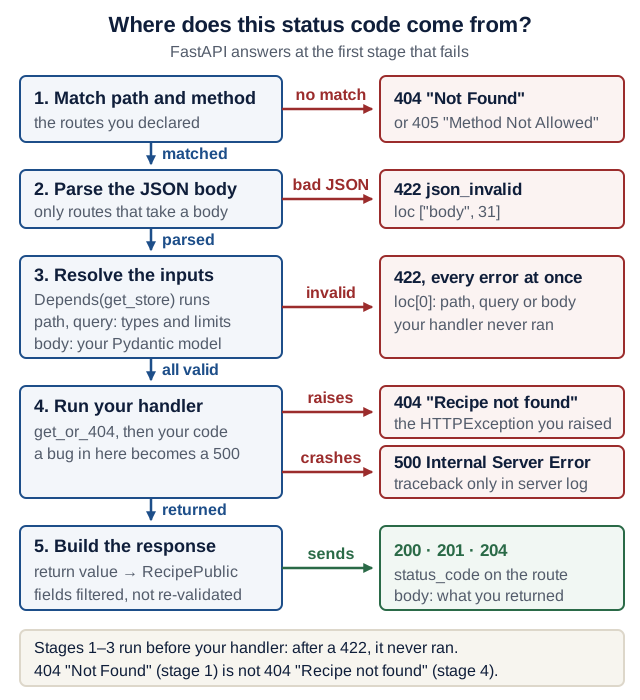
Text version of the diagram
FastAPI answers at the first stage that fails:
- Match the path and method against the routes you declared. No route has this path:
404with{"detail": "Not Found"}. The path exists, but not with this method:405with{"detail": "Method Not Allowed"}. - Parse the JSON body, only for routes that take a body. Invalid JSON:
422with typejson_invalidand alocsuch as["body", 31](the character position). - Resolve the inputs. The dependency
get_storeruns; path and query parameters are converted and checked (recipe_id: int,limitat most 100); the body is validated against your Pydantic model. Every error is collected into one422, andloc[0]says where:"path","query"or"body". Your handler never ran. - Run your handler.
get_or_404raisesHTTPException:404with{"detail": "Recipe not found"}. Any uncaught exception becomes500 Internal Server Error; the client sees only that text, and the traceback appears only in the server log. - Build the response. The return value goes through the return type
RecipePublic, which filters fields but does not re-validate a model object you return. The status is the route’s200,201or204.
Two reading rules: after a 422, your handler never ran; and 404 "Not Found" (stage 1) is a different problem from 404 "Recipe not found" (stage 4).
Check yourself: PATCH /recipes/999 (no such recipe) with the body {"minutes": 0}. Is the answer 404 or 422?
Check your answer
422 with greater_than_equal at ["body", "minutes"]. Validation (stage 3) runs before your handler (stage 4), so get_or_404 never gets the chance to say the recipe is missing.
Simulator: which stage answers? Pick one of six requests, predict its status code, then step through the five stages until one of them writes the response.
Worked example (bodies exactly as the Lecture 2 API returns them):
- Valid POST
{"title": "Shakshuka", "minutes": 25}on a fresh server passes all five stages:201 Createdwith{"title":"Shakshuka","minutes":25,"servings":2,"ingredients":"","tags":"","id":1}. - Missing field
{"title": "Soup"}stops at stage 3:422with{"detail":[{"type":"missing","loc":["body","minutes"],"msg":"Field required","input":{"title":"Soup"}}]}. - Wrong type
{"title": "Soup", "minutes": "soon"}stops at stage 3:422with typeint_parsingat["body","minutes"]. - Unknown id
GET /recipes/999stops at stage 4, in your handler:404with{"detail":"Recipe not found"}. - Unknown path
GET /recipe/1stops at stage 1, before any of your code:404with{"detail":"Not Found"}. - DELETE twice
DELETE /recipes/1: the first call answers204with an empty body; the second stops at stage 4 with404and{"detail":"Recipe not found"}.
The interactive version of this simulator needs JavaScript; the worked example above is the same model.
OpenAPI describes this API; OpenAI is a different name
OpenAPI is the machine-readable description FastAPI publishes at /openapi.json; /docs renders an interactive view. It describes operations, inputs and responses. OpenAI is a company whose model API we may call later. You can build today’s complete API without any model provider or model account.
Two-minute check, after starting the demo below: open /openapi.json, find paths → /recipes → post, and locate its request schema and declared success response. Compare those declarations with the handler and one API test. Which part describes the request, and which running code validates it? A schema snapshot is evidence of a declared contract; it does not prove the deployed service still follows it or that a caller is authorized. Lecture 7 turns this distinction into a cross-service check.
The optional API vocabulary table is a reference if the similar names become confusing. No provider setup is part of this check.
Live demo
The instructor grows Recipe Box; every command runs from backend/ unless a step says otherwise.
1. Add the dev tools (from backend/). State the contract. Tests import Starlette’s TestClient, which wants httpx2; with only httpx installed it raises a deprecation warning, and our settings below turn warnings into failures.
uv add --dev pytest ruff httpx2
Version note: FastAPI 0.143.3, the current release on 17 October 2026, installs httpx but not httpx2 with fastapi[standard]. A change merged that day (fastapi#16512) adds httpx2 to the standard extra from the next release. Listing it as a dev dependency makes the test requirement explicit either way. (Checked 17 October 2026.)
Append to backend/pyproject.toml:
[tool.pytest.ini_options]
pythonpath = ["."]
testpaths = ["tests"]
addopts = "-q"
filterwarnings = ["error"]

[tool.ruff.lint]
extend-select = ["I", "FAST"]
pythonpath lets tests import app; filterwarnings = ["error"] turns deprecation warnings into failures.
2. The contract. State the contract.
# backend/app/models.py
from pydantic import BaseModel, ConfigDict, Field


class RecipeBase(BaseModel):
    """Fields shared by every recipe schema."""

    title: str = Field(min_length=1, max_length=200)
    minutes: int = Field(ge=1, le=24 * 60)
    servings: int = Field(default=2, ge=1, le=50)
    ingredients: str = Field(default="", max_length=5000)  # one per line
    tags: str = Field(default="", max_length=500)  # comma-separated


class RecipeCreate(RecipeBase):
    """POST body. Unknown fields -> 422 instead of being silently ignored."""

    model_config = ConfigDict(extra="forbid", str_strip_whitespace=True)


class RecipeUpdate(BaseModel):
    """PATCH body: every field optional; send only what changes."""

    model_config = ConfigDict(extra="forbid", str_strip_whitespace=True)

    title: str | None = Field(default=None, min_length=1, max_length=200)
    minutes: int | None = Field(default=None, ge=1, le=24 * 60)
    servings: int | None = Field(default=None, ge=1, le=50)
    ingredients: str | None = Field(default=None, max_length=5000)
    tags: str | None = Field(default=None, max_length=500)


class RecipePublic(RecipeBase):
    """Response body: what clients see (always has an id)."""

    id: int
3. The routes. Make the smallest change. The store is a dict behind a dependency, and the routes never touch it any other way.
# backend/app/main.py
from dataclasses import dataclass, field
from typing import Annotated

from fastapi import Depends, FastAPI, HTTPException, Query, status

from app.models import RecipeCreate, RecipePublic, RecipeUpdate


@dataclass
class RecipeStore:
    """A dict standing in for a database. Restart the server: data is gone."""

    rows: dict[int, RecipePublic] = field(default_factory=dict)
    last_id: int = 0


store = RecipeStore()


def get_store() -> RecipeStore:
    return store  # tests swap in a fresh store via app.dependency_overrides


StoreDep = Annotated[RecipeStore, Depends(get_store)]

app = FastAPI(title="Recipe Box API")


def get_or_404(store: RecipeStore, recipe_id: int) -> RecipePublic:
    if recipe_id not in store.rows:
        raise HTTPException(status.HTTP_404_NOT_FOUND, detail="Recipe not found")
    return store.rows[recipe_id]


@app.get("/health")
def health() -> dict[str, str]:
    return {"status": "ok"}


@app.get("/recipes")
def list_recipes(
    store: StoreDep,
    offset: Annotated[int, Query(ge=0)] = 0,
    limit: Annotated[int, Query(ge=1, le=100)] = 50,
) -> list[RecipePublic]:
    return list(store.rows.values())[offset : offset + limit]


@app.post("/recipes", status_code=status.HTTP_201_CREATED)
def create_recipe(body: RecipeCreate, store: StoreDep) -> RecipePublic:
    store.last_id += 1
    recipe = RecipePublic(id=store.last_id, **body.model_dump())
    store.rows[recipe.id] = recipe
    return recipe


@app.get("/recipes/{recipe_id}")
def get_recipe(recipe_id: int, store: StoreDep) -> RecipePublic:
    return get_or_404(store, recipe_id)


@app.patch("/recipes/{recipe_id}")
def update_recipe(recipe_id: int, body: RecipeUpdate, store: StoreDep) -> RecipePublic:
    recipe = get_or_404(store, recipe_id)
    # Only fields the client sent; null means "leave unchanged".
    changes = body.model_dump(exclude_unset=True, exclude_none=True)
    store.rows[recipe_id] = recipe.model_copy(update=changes)  # already validated
    return store.rows[recipe_id]


@app.delete("/recipes/{recipe_id}", status_code=status.HTTP_204_NO_CONTENT)
def delete_recipe(recipe_id: int, store: StoreDep) -> None:
    get_or_404(store, recipe_id)
    del store.rows[recipe_id]
In PATCH, exclude_unset=True keeps only the fields the client sent. model_copy(update=...) does not validate; that is safe only because RecipeUpdate already did. This toy store is also unsafe under concurrent requests: FastAPI runs plain def routes in a thread pool, so two POSTs can race on last_id += 1 and receive the same id. Next week’s database assigns ids inside a transaction.
4. Happy and error requests. Observe the real result. Start uv run fastapi dev in backend/; the curls run in a second terminal, from any folder.
Predict: before you send each request below, write down its status code and, for an error, the stage in the figure above that answers.
curl -i --json '{"title": "Shakshuka", "minutes": 25}' localhost:8000/recipes
curl localhost:8000/recipes/1
curl localhost:8000/recipes/999
curl --json '{"title": "", "minutes": 0}' localhost:8000/recipes
curl --json '{"title": "Soup", "minutes": 40, "chef": "me"}' localhost:8000/recipes
curl -X PATCH --json '{"minutes": 30}' localhost:8000/recipes/1
curl -i -X DELETE localhost:8000/recipes/1
curl "localhost:8000/recipes?limit=101"
Check your predictions
201with the new recipe and"id":1.200with the same recipe.404{"detail":"Recipe not found"}(stage 4: your handler ran).422with two errors,string_too_shortandgreater_than_equal, both reported at once (stage 3).422extra_forbiddenat["body", "chef"](stage 3).200with"minutes":30; the title is unchanged.204with an empty body.422less_than_equalat["query", "limit"](stage 3).
--json needs curl 7.82 or newer; Ubuntu 22.04 ships 7.81 and answers option --json: is unknown. --json is a shortcut for sending the data with the header Content-Type: application/json (plus Accept: application/json), so this works on any curl:
curl -i -X POST -H 'Content-Type: application/json' -d '{"title": "Shakshuka", "minutes": 25}' localhost:8000/recipes
curl -X PATCH -H 'Content-Type: application/json' -d '{"minutes": 30}' localhost:8000/recipes/1
Repeat a few in http://localhost:8000/docs with “Try it out”.
Explain after: switch to the server terminal and match each curl to its access-log line, such as INFO: 127.0.0.1:63541 - "POST /recipes HTTP/1.1" 422 Unprocessable Content. Which of the eight requests never reached your handler code?
Show a model answer
The three 422 requests (4, 5 and 8) stopped in stage 3, before your handler ran. Every request still gets an access-log line, which is how you can debug a client you cannot see: the log shows the method, the path, the query string and the status the server sent.
Optional: watch a 500 happen. Add 1 / 0 as the first line of get_recipe and save. curl -i localhost:8000/recipes/1 now prints only HTTP/1.1 500 Internal Server Error and the body Internal Server Error. The server terminal shows the access-log line, ERROR: Exception in ASGI application, and a traceback ending in ZeroDivisionError: division by zero. That split is deliberate: details stay on the server. Delete the line again.
Predict: create one more recipe and check that curl localhost:8000/recipes lists it. Then, in the second terminal, run touch app/main.py from backend/ (it changes the file’s timestamp, not its content). What does curl localhost:8000/recipes return now, and why?
Check your prediction
[]. The server terminal prints WatchFiles detected changes in 'app/main.py'. Reloading...: fastapi dev started a fresh Python process, and the dict lived in the old process’s memory. A restart, a crash or a redeploy loses it the same way. That is next week’s problem, and a database is the fix.
Trace it: follow PATCH /recipes/1 with the body {"title": null} through the code, assuming recipe 1 is "Soup", 40 minutes. Fill in the cells marked ? before you open the answer.
| Step | File : function | Input | State after | Next call |
|---|---|---|---|---|
| 1 | app/models.py : RecipeUpdate (stage 3) | {"title": null} | body.title is None; "title" is in body.model_fields_set | update_recipe |
| 2 | app/main.py : get_or_404 | store, 1 | recipe is Soup, 40 minutes | body.model_dump(...) |
| 3 | app/main.py : update_recipe | exclude_unset=True, exclude_none=True | changes is ? | recipe.model_copy(update=changes) |
| 4 | app/main.py : update_recipe | update=changes | stored title is ? | return |
| 5 | FastAPI (stage 5) | RecipePublic | status ?, "title": ? | — |
Check your answer
Step 3: changes is {}, because exclude_none=True drops the None. Step 4: the stored title is still "Soup". Step 5: 200 with "title": "Soup". Now change one argument: without exclude_none=True, step 3 gives {"title": None}, model_copy copies it in without validation, and the response says "title": null. Break-it drill 2 makes exactly that change.
5. The tests. State the contract. TestClient calls the app in-process, with no server. The fixture gives every test a fresh store:
# backend/tests/conftest.py
from collections.abc import Iterator

import pytest
from fastapi.testclient import TestClient

from app.main import RecipeStore, app, get_store


@pytest.fixture
def client() -> Iterator[TestClient]:
    store = RecipeStore()  # a fresh, empty store for every test
    app.dependency_overrides[get_store] = lambda: store
    yield TestClient(app)
    app.dependency_overrides.clear()
Three of the ten tests in backend/tests/test_recipes.py. The comment at the top is the testing strategy: the partitions each input splits into, so you can see which test protects which rule. (Writing partitions down first is inspired by MIT 6.102’s reading on testing; EASS is not affiliated with MIT.)
# backend/tests/test_recipes.py (excerpt)
# Testing strategy: split each input into partitions and test at least one value
# from each, especially both sides of every limit. A test counts only if it fails
# when the rule it protects is broken.
#   title: missing | "" | whitespace only | 1-200 chars | 201 chars
#   minutes: 0 | 1-1440 | 1441        servings: 1-50 | 51
#   fields: only known ones | an unknown one ("chef")
#   recipe id: exists | missing (GET, PATCH, DELETE)
from fastapi import status

SOUP = {"title": "Soup", "minutes": 40}


def test_create_returns_201_with_defaults(client):
    r = client.post("/recipes", json=SOUP)
    assert r.status_code == status.HTTP_201_CREATED
    body = r.json()
    assert body["id"] >= 1
    assert (body["title"], body["minutes"]) == ("Soup", 40)
    assert body["servings"] == 2  # defaults
    assert body["ingredients"] == body["tags"] == ""


def test_unknown_field_is_rejected(client):
    r = client.post("/recipes", json={**SOUP, "chef": "me"})
    assert r.status_code == 422
    assert r.json()["detail"][0]["type"] == "extra_forbidden"


def test_missing_recipe_is_404(client):
    for method in ("GET", "PATCH", "DELETE"):
        body = {} if method == "PATCH" else None  # PATCH must pass validation first
        r = client.request(method, "/recipes/999", json=body)
        assert r.status_code == 404, method
        assert r.json() == {"detail": "Recipe not found"}
The other seven cover health, read-after-create, pagination (limit=101 is a 422), seven invalid bodies, PATCH (partial, null, invalid), delete-then-404, and isolation. Paste them below the excerpt to get the full file:
Show the other seven tests
# backend/tests/test_recipes.py (continued)
def test_health(client):
    assert client.get("/health").json() == {"status": "ok"}


def test_get_returns_what_was_created(client):
    created = client.post("/recipes", json=SOUP).json()
    assert client.get(f"/recipes/{created['id']}").json() == created


def test_list_is_paginated(client):
    for n in range(3):
        client.post("/recipes", json={"title": f"R{n}", "minutes": 5})
    assert [r["title"] for r in client.get("/recipes").json()] == ["R0", "R1", "R2"]
    page = client.get("/recipes", params={"offset": 1, "limit": 1}).json()
    assert [r["title"] for r in page] == ["R1"]
    assert client.get("/recipes", params={"limit": 101}).status_code == 422


def test_invalid_bodies_are_422(client):
    bad_bodies = [
        {"title": "", "minutes": 20},  # too short
        {"title": "   ", "minutes": 20},  # whitespace is stripped first
        {"title": "x" * 201, "minutes": 20},  # one over the limit
        {"title": "x", "minutes": 0},  # minutes >= 1
        {"title": "x", "minutes": 24 * 60 + 1},  # minutes <= 1440
        {"title": "x", "minutes": 5, "servings": 51},  # servings <= 50
        {"minutes": 5},  # title missing
    ]
    for body in bad_bodies:
        r = client.post("/recipes", json=body)
        assert r.status_code == status.HTTP_422_UNPROCESSABLE_CONTENT, body


def test_patch_changes_only_sent_fields(client):
    rid = client.post("/recipes", json=SOUP).json()["id"]
    r = client.patch(f"/recipes/{rid}", json={"minutes": 35})
    assert r.status_code == 200
    assert (r.json()["title"], r.json()["minutes"]) == ("Soup", 35)
    # null means "leave unchanged"; a stored None would break the contract
    # (in Lecture 3 the database rejects it with a 500)
    assert client.patch(f"/recipes/{rid}", json={"title": None}).status_code == 200
    assert client.patch(f"/recipes/{rid}", json={"minutes": 0}).status_code == 422


def test_delete_then_404(client):
    rid = client.post("/recipes", json=SOUP).json()["id"]
    r = client.delete(f"/recipes/{rid}")
    assert r.status_code == status.HTTP_204_NO_CONTENT
    assert r.content == b""
    assert client.get(f"/recipes/{rid}").status_code == 404
    assert client.delete(f"/recipes/{rid}").status_code == 404


def test_each_test_starts_empty(client):
    assert client.get("/recipes").json() == []
Observe the real result (from backend/):
uv run pytest
uv run ruff check .
uv run ruff format --check .
Expected: 10 passed, All checks passed!, and all files already formatted. This test file stays unchanged through Lecture 10: storage changes, the contract does not.
Investigate:
- Which line of
conftest.pymakes each test start with an empty store, and which line undoes it?- Why does
test_missing_recipe_is_404send a body only for PATCH? What would PATCH answer without one?- If someone changed
max_length=200to201inRecipeBase, which test would go red, and with what message?
Show model answers
app.dependency_overrides[get_store] = lambda: storehands every route this test’s freshstore;app.dependency_overrides.clear()afteryieldremoves the override, so the next test starts clean.- PATCH takes a body, and validation (stage 3) runs before the handler. Without a body, PATCH answers
422with typemissingat["body"], never reachingget_or_404. GET and DELETE take no body, so the test sends none. test_invalid_bodies_are_422(1 failed, 9 passed). pytest prints the failing body, the 201-character title, as the assertion message, thenassert 201 == 422: the server created a recipe it should have refused. That is the partition comment at work: the201 charscase exists so that this mistake is caught.
Hands-on lab
Build the same API for your record type, from your repo’s backend/. Plan your time:
- Core today: steps 1–4
- Before Lecture 3: step 5
- Extension (optional): the Stretch goals
- Models. Translate your data sketch into
app/models.pywith the four-model split. Give every field a type and a limit, and decide which fields have defaults. Checkpoint:/docsshows your Create, Update and Public schemas. - Routes. Add the five contract routes, renamed for your resource (for example
/tasks/{task_id}), using the store dependency andget_or_404. Checkpoint: POST returns 201 with anid; a missing id returns 404 with yourdetail. - Predict, then send. In your README, write six requests (two happy, four broken) with predicted status codes and stages. Send them, then correct your predictions. Checkpoint: you can explain each 422 from its
locandmsg, and each 404 from itsdetail. - Tests. Copy the fixture. Write the testing-strategy comment for your record first: every field’s partitions, including both sides of each limit. Then write one test per partition (usually 8 or more), plus 404 on GET, PATCH and DELETE, and isolation (tests with pytest). Checkpoint: every partition in your comment has a test, ruff is clean, and changing one limit in your model turns a named test red. A failure case to watch for: a test that still passes after you break the rule it names protects nothing; fix the test.
- Ship it on a branch with a PR on your own repo, as in Lecture 1. Before the PR, add
## Runand## Testsections to your README with the exact commands (cd backend,uv run fastapi dev;cd backend,uv run pytest,uv run ruff check .), and an## AI useline for any assistant help this week. Checkpoint:gh pr list --state mergedshows it, and a classmate can follow your Run and Test sections in a fresh terminal.
Optional: practise the partition step of the engineering studio routine on your title field with a partner: valid, empty, whitespace only, missing, null, wrong type.
EX1 progress: after today you have CRUD, validation, tests, and run and test instructions. Still to come next week: persistent data and a backend Dockerfile. EX1 is due Mon 9 Nov 2026, 23:59 (assignments).
Break it on purpose
Break it, run uv run pytest from backend/, read the failure, then restore the code. Predict before each run.
Drill 1 · Forget the forbid. Remove extra="forbid" from both models. Which test fails, and what does its assertion line say?
Check your prediction
test_unknown_field_is_rejected fails with assert 201 == 422: the typo field was silently dropped and the recipe was created. Use the same move to check an AI-written test: break the code it protects, and the test must go red.
Drill 2 · A bug the tests miss. Change the PATCH line to body.model_dump(exclude_unset=True). How many of the ten tests fail? What does PATCH {"title": null} return now?
Check your prediction
None: all ten tests still pass, yet PATCH {"title": null} now returns "title": null. model_copy skipped validation, and FastAPI trusts a model object you return (your trace above, step 3). The existing PATCH test checks only the status code. Add this regression test, watch it fail with AssertionError: assert None == 'Soup', then restore exclude_none=True:
# backend/tests/test_patch_null.py
def test_patch_null_keeps_the_old_value(client):
    rid = client.post("/recipes", json={"title": "Soup", "minutes": 40}).json()["id"]
    client.patch(f"/recipes/{rid}", json={"title": None})
    assert client.get(f"/recipes/{rid}").json()["title"] == "Soup"
The lesson: assert the body, not just the status code. Keep the file until Lecture 3, where the database turns this bug into a 500 that test_patch_changes_only_sent_fields catches.
Optional: look inside instead of guessing. With the broken line and the regression test in place, run uv run pytest -x --pdb tests/test_patch_null.py. At the (Pdb) prompt, type p client.get(f"/recipes/{rid}").json(): you see the stored recipe with 'title': None. Type q to quit. The method behind this is the debug log: a hypothesis first, then one experiment.
Drill 3 · Shared state. Make the fixture return a plain TestClient(app) with no override. Which tests fail, and why might the result change if the tests ran in another order?
Check your prediction
test_list_is_paginated and test_each_test_starts_empty fail (Left contains … more items; the count depends on test order): earlier tests left recipes behind in the one global store. Results that depend on test order are the definition of a flaky suite.
Debug log: for drill 3, write the seven-line debug log entry in your notes. Write the hypothesis before you look at the fixture again.
Open-source track
This week: find one real issue or documentation gap in your best candidate, and ask before doing anything big (etiquette).
gh label list -R OWNER/REPO --limit 100
gh issue list -R OWNER/REPO --state open --label "documentation"
gh issue view NUMBER -R OWNER/REPO
gh issue view NUMBER -R OWNER/REPO --comments
gh pr list -R OWNER/REPO --state all --search "words from the issue"
- Labels differ per project, so check the list first.
- Read the body, who is assigned, and all comments. If someone is assigned or an open PR already fixes it, move on. On 16 October 2026, one documentation issue in a large project already had two competing open PRs.
- Documentation gaps count. Follow the project’s tutorial in a fresh folder; a step that fails or assumes unexplained knowledge is a candidate.
- Ask first for anything beyond a typo: describe what you found and propose a fix, in your own words.
Read one real review first (about 10 min). In your candidate, find a merged PR from an outside contributor with real review discussion, for example with gh pr list -R OWNER/REPO --state merged --search "comments:>3" --limit 10; a head branch shown as user:branch usually came from a fork. Open it with gh pr view NUMBER -R OWNER/REPO --comments. In your README shortlist row, note two things the reviewers asked for and three norms of the project: are tests required, is a changelog entry needed, and is there a commit-message or sign-off (DCO) rule? This step is inspired by Missing Semester 2026, “Beyond the Code” and Stanford’s CS146S; EASS is not affiliated with either.
Add the issue URL and your plan to your README. In Lecture 3 you reproduce it and open PR #1.
Working with AI assistants
- Tests first. “Here are my models and route table. Write pytest tests with a
clientfixture, including 404 and 422 cases. Don’t write the routes.” Run them before the routes exist: they must fail. - Nasty inputs. “List ten invalid JSON bodies for this model, each with the Pydantic v2 error
typeyou expect.” Send them and compare with the realdetail[0]["type"]. - Explain a 422. Paste the full JSON and ask which field broke the contract.
From this week, use the longer work order: now that you have tests, add Acceptance and Stop to Lecture 1’s five lines. An example for an optional feature (it is also a fine stretch goal):
Outcome:      GET /recipes?tag=vegan returns only recipes whose comma-separated
              tags contain "vegan" (case-insensitive); an unknown tag returns
              200 with []
Files:        backend/app/main.py, backend/tests/test_tag_filter.py (new)
Non-goals:    no change to the models, to other routes, or to
              tests/test_recipes.py
Verify with:  (from backend/) uv run pytest, then uv run ruff check .
Review focus: tags are split on commas and compared whole, so tag=veg
              does not match "vegan"
Acceptance:   tests/test_tag_filter.py fails before the change because
              all recipes come back
Stop:         if the change seems to need a new dependency or a model
              change, stop and report
Run the new test before the change and read why it fails. If it already passes, record already satisfied and stop; never manufacture a failure. Afterwards, add one line to your README’s ## AI use note: the tool, what it produced, and the command you ran to check it.
Spot the outdated suggestion. Each of these raises a deprecation warning, which filterwarnings = ["error"] turns into a failing test:
class Config: extra = "forbid"inside a model. Usemodel_config = ConfigDict(extra="forbid")..dict(). Use.model_dump().status.HTTP_422_UNPROCESSABLE_ENTITY. Usestatus.HTTP_422_UNPROCESSABLE_CONTENT.
Completion check
From backend/, with uv run fastapi dev running in a second terminal:
uv run pytest
uv run ruff check .
curl -s -o /dev/null -w "%{http_code}\n" http://localhost:8000/recipes/999
curl -s -o /dev/null -w "%{http_code}\n" --json '{}' http://localhost:8000/recipes
Expected: N passed (N is at least 8), All checks passed!, 404, and 422. Use your own resource path. On curl older than 7.82, replace --json '{}' with -H 'Content-Type: application/json' -d '{}'.
| Must work | Evidence you keep | If it fails, repair here |
|---|---|---|
Five CRUD routes plus /health for your record type, with the contract’s status codes | The four commands above, pasted in your PR description | Status codes you must own · the status-code figure |
Separate Create, Update and Public models, with extra="forbid" and a limit on every field | /docs screenshot or the schemas in your PR | Pydantic: the contract as code |
uv run pytest prints N passed (N at least 8); tests assert status codes and bodies, with a fresh store per test | Terminal output in your PR description | Break it on purpose · Tests with pytest |
README has ## Run and ## Test sections that a classmate followed | README on GitHub | Lab step 5 |
| One issue or documentation gap noted for your open-source candidate, plus the review norms you read | README shortlist row | Open-source track |
Not yet? Repair and re-run before starting the next lecture’s lab; later layers assume this one works.
Quick quiz
Q1. A client retries POST /recipes after a timeout, and both requests arrive. What happens? (a) One recipe, since POST is idempotent (b) Two recipes with two different ids (c) A 409 Conflict for the retry
(b). Each POST creates a new resource with a new id, like f(x) = x + 1: POST is not idempotent. Nothing in this API looks for duplicates, so no 409 comes back either. Retrying a POST needs care, which Lecture 9 returns to.
Q2. A client sends "minutes": "40" (a string) to POST /recipes. What does this API return? (a) 422, because "40" is a string (b) 500, because the handler gets text (c) 201, with minutes stored as 40
(c). Pydantic’s default lax mode converts a numeric string to an int. "forty" cannot convert, so it gets 422 int_parsing. Strict mode rejects any string. Either way, validation runs before your handler (stage 3), so the handler never receives text.
Q3. GET /recipe/1 (no "s") returns {"detail": "Not Found"}. What does that tell you? (a) No route matched the request path (b) The handler found no recipe 1 (c) The store has no recipes yet
(a). Your handler would have said "Recipe not found", whether recipe 1 was deleted or the store is empty. The generic "Not Found" means no route matched, so check the path.
Q4. Why does the client fixture override get_store? (a) Tests can run without a live server (b) Each test gets its own empty store (c) The suite runs faster with fewer rows
(b). Shared state makes tests depend on each other’s leftovers (drill 3), so results change with test order. TestClient is what removes the server, with or without the override. Next week the same override swaps in a test database.
Q5. (Lecture 1) At the repo root, uv run pytest says "Failed to spawn: pytest". Why? (a) No uv project at the root (b) A syntax error in a test (c) FastAPI is missing from global Python
(a). uv run uses the nearest pyproject.toml; the root has none, so backend/.venv is never used. “Failed to spawn” means uv found no pytest program to start, so no test file was read and a syntax error cannot be the cause. With a global pytest you get No module named 'fastapi' instead, for the same reason. Run cd backend first.
Explain it: in one sentence, what is get_or_404 for? (Not what each line does.)
Show a model answer
- Weak (narrates lines): “It checks whether the id is in
store.rows, raises anHTTPExceptionif not, and returns the row.” - Strong (purpose and the failure it prevents): “It gives every route one shared way to turn ‘no such recipe’ into the contract’s
404 Recipe not found, so no route can forget the check and crash with aKeyErrorthat the client would see as a 500.”
Defend it: the Recipe Box contract answers
404when a client deletes a recipe that does not exist; some APIs answer204. Defend the course’s choice with one reason from the contract or the tests, and name one cost.
What a strong answer mentions
- Reason:
404tells the client something true and useful (this id does not exist, perhaps a typo or a stale list), it matches what GET and PATCH say for the same id, andtest_delete_then_404pins it down. DELETE stays idempotent because the server state is the same either way. - Cost: a client that retries a DELETE after a timeout may see
404for a delete that actually succeeded the first time, so it must treat404as “already gone” rather than as an error. A204answer avoids that special case at the price of hiding typos.
Stretch goals
Optional, after your tests pass:
- Add
PUT /recipes/{recipe_id}that replaces the whole record (aRecipeCreatebody), and test that two identical PUTs leave the same state. - Add the
?tag=filter from the work order above, or aqquery parameter that filters titles case-insensitively, each with a test that fails first. - In your own product, convert an invalid-bodies loop to
@pytest.mark.parametrize, so each bad body is reported as its own test. Simpler is enough: the loop is fine for the course demo, whose checker expects exactly ten tests; parametrizing changes that count, so do it only in your own repo. - Try HTTPie:
uvx --from httpie http POST :8000/recipes title=Soup minutes:=40(:=sends a JSON number).
Common pitfalls
option --json: is unknownfrom curl → your curl is older than 7.82 (Ubuntu 22.04 ships 7.81) → use-H 'Content-Type: application/json' -d '{...}', as in demo step 4, or upgrade.- 422
model_attributes_typefrom curl →-dwithout a JSON content type sends form data → use--json, or add-H "Content-Type: application/json". - 422
missingat["body"]on PATCH or POST → you sent no body → send JSON, even if it is only{}. ModuleNotFoundError: No module named 'app'in tests → missingpythonpath = ["."]→ add it to[tool.pytest.ini_options].StarletteDeprecationWarning: Using httpx with starlette.testclient is deprecated→httpx2is not installed →uv add --dev httpx2.- Data vanishes while coding →
fastapi devrestarts on save → expected until Lecture 3. - A test passes alone but fails in the full run → shared state → use the fixture override.
Instructor notes
Suggested flow, with a minute budget per segment (estimates):
- Warm-up: the three warm-up questions, then students label every part of the raw request and response (10 min).
- REST smell test on five URLs; idempotency with
|x|versusx + 1(10 min). - Live: models, then routes, with
/docsopen throughout; the absent,nulland value table (20 min). - Prediction round with the status-code figure: students call each status code and stage before you run each curl; then match the access log (15 min).
- Write
conftest.pyand two tests live, then reveal the rest; read the partition comment together (15 min). - Drill 2 live: ten green tests hide a real bug until you add the regression test. Peer-instruction vote before you run it: “how many of the ten tests fail?” (10 min).
- Lab: circulate and read 422 bodies with students (rest of the meeting).
- Open-source step:
gh issue listandgh pr list --searchon one repo (5 min). - Exit ticket: a status code you used to confuse; the issue you found (5 min).
Core path if time runs short: segments 3, 4 and 6, so everyone has seen the contract, the stage order and a test that misses a bug; the warm-up and the open-source step move to the lab.
Emphasize that the contract is the product and storage is a detail; keep the 204-versus-404 debate short. Students get stuck on the JSON content type, PATCH semantics (unset versus null), and tests that only check status codes.
Read more
Before the lab (≤15 min): FastAPI: testing. Read with two questions: what does TestClient replace, and what can it not tell you about a real server? How do you send a JSON body from a test?
Go deeper (optional):
- FastAPI: request body and handling errors
- FastAPI: partial updates with PATCH and overriding dependencies in tests
- Pydantic: models and fields
- MDN: HTTP request methods and status codes
- pytest: fixtures
- RFC 7396: JSON Merge Patch, the alternative meaning of
nullin a PATCH - Course sites that go further on testing and API design: Further study